Steampug prints are go!:
http://www.etsy.com/listing/79004509/steampug-print?ref=pr_shop

art, animation, & nonsense
Steampug prints are go!:
http://www.etsy.com/listing/79004509/steampug-print?ref=pr_shop
The talented Professor HerpaDerpalus has used SCIENCE to summon Steampug into the third dimension. He has also been given a nifty propulsion system.
http://www.polycount.com/forum/showthread.php?t=87084

…It should also be noted that the good Professor suggested as plausible an origin story as I’ve heard: “some mad inventor thought his dog wanted to see the world and made a baloon for him, not realizing the dog will end up a tiny skeleton attached to a baloon in a bit.”
Steampug shirts are now in production and are available for pre-order! Get yours before the Prussians buy them all up.
http://www.etsy.com/listing/78063380/steampug-tee-preorder#shipping
For now, a much higher quality image of our dashing hero. Prints and shirts and whatnot are in the works. Soon, soon.
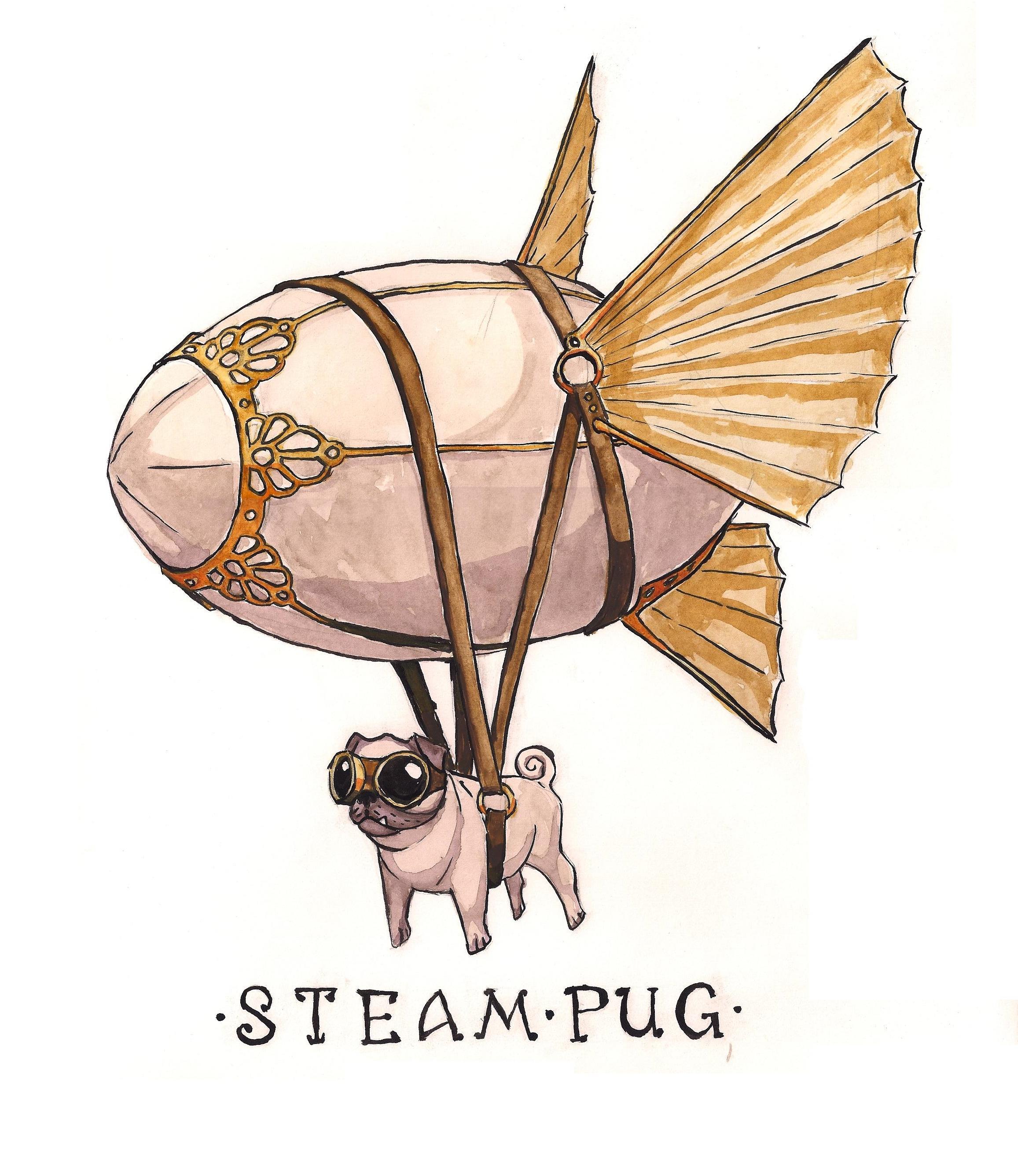
A couple months ago, I drew a very silly picture based on a fragment of a late night conversation.
This is Steampug.

In the approximate month-and-a-half since Steampug rode his zeppelin into the strange aether of the internet, he has cropped up on a number of sites, including tumblr, where he has received 2,044 loves/reblogs (as of yesterday). This is more than the total hits to date for this website, and probably more people than have seen any one of my “serious” pieces.
So… t-shirts?
“Therefore, the first step in our criticism of customary concepts and customary reactions is to step outside the circle and either to invent a new conceptual system, for example a new theory, that clashes with the most carefully established observational results and confounds the most plausible theoretical principles, or to import such a system from outside science, from religion, from mythology, from the ideas of incompetents, or the ramblings of madmen.”
Paul Feyerabend, Against Method
I recently visited the CMA’s exhibit of medieval reliquaries. The official lit on the exhibit made much about the power of memory and the function of the relics as mementos linking the worshippers to their collective past, and while this probably has some validity, I doubt that medieval Christians thought about these objects in such psychologized terms. It’s always risky to speculate on what a group of people a thousand years ago “really” thought about their cultural constructs, but what I saw of these objects leads me to believe that the whole system of relics and reliquaries bespeaks a peculiarly material, even mechanical, approach to religious practice.
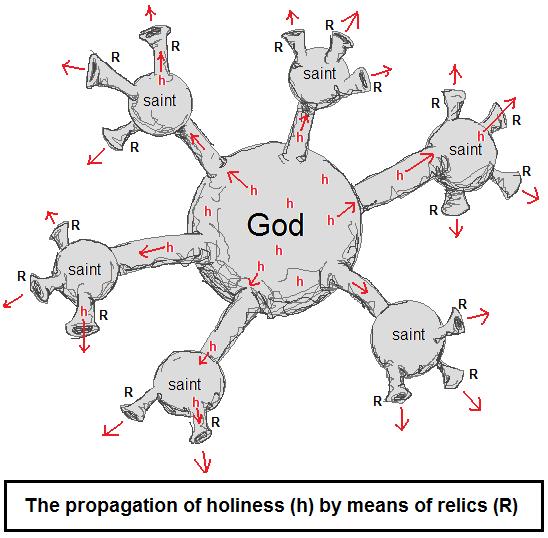
The basic theory hinges on a quantity that, for lack of a better term, we might call “holiness”. This is what the medieval pilgrim would have sought, and what the relics would purport to give access to. Etherial as this concept might seem at first blush, a couple of things can be said about it with some confidence:
Firstly, holiness (h hereafter) is good. We must clarify that “good” is intended in its most objective, unequivocal sense, and as so h functions as an end in itself. Having h or being in its presence is better than the alternative, whatever other effects might be attributed to it. That being said, h has practical functions, and these follow from its essential goodness. The supposed miraculous properties of a relic owe to its resident h increasing the goodness of those around it in a very concrete (if unpredictable) fashion.
Second, h can be said to act as a physical substance. Its existence is spatial and temporal; it exists in higher concentrations in certain places, times, and, in the case of relics, objects. One might even speak of h-gradients. In other contexts however, it displays properties of energy, particularly heat. For example, a high-h object such as a relic might provoke people to touch it, in hopes of absorbing some of its h. h, like heat, would seem to conduct from regions of higher to lower “temperature”. With this in sight, it makes sense that the church would strive to insulate relics as thoroughly as possible. A sort of Second Law of Theodynamics seems to be at work here, and h-entropy is to be avoided at all costs. The only significant departure from classical physics lies in the fact that h conducts not only via physical but also historical contact. A saint’s toenail continues to receive h from the saint long after it has been clipped and its owner martyred. Sir James Frazier called this the Law of Contagion, but for our purposes we can call it the Principle of Conduction-by-Association.
With these principles in sight, we may define relics as implements of controlled h-propagation. To our medieval votaries, the ultimate source of h was, of course, God, but this source was distant and therefore, like a faraway power plant, not reliable as a direct resource. Hence the need for an accessible system for the dissemination of this commodity, a system in which relics formed the ultimate “outlets”. We may map the flow of h thusly:
By most accounts, the Liars’ talents were put to distinctly petty ends- spreading rumors about the sickliness of a rival’s livestock, which would invariably sicken accordingly- inventing tales of treasures hidden in a given place, then going to find the money hidden exactly where their stories said it would be. However, accounts exist of certain extraordinary Lies that shaped events on a grand scale. One such Lie was told in the 15th century, in what is now Hungary, following the assassination of Prince Lazlo of Elgenburg. Historians agree that Lazlo’s death was arranged by the Holy Roman Emperor Sigismund I in an effort to seize control of the city state over which he ruled. Shortly thereafter, a cadre of Lazlo’s followers sought assistance from the famed Liar Nicholas Hermány.
It is said that Hermány arrived at the appointed meeting place masked and cloaked from head to foot so as to conceal his identity from the almighty, as was the custom of itinerant Liars. Impassively, he heard out the conspirators, and when he finally spoke, even his voice was masked by a rapidly shifting series of affected intonations and dialects, now coming out in shrieking falsetto, now in a guttural snarl, now in a heavy Turkish accent with a pronounced lisp. He described his plan in the briefest possible terms, and left without formality. Whatever payment he demanded for his service (if any), remains lost to history.
The very next day, leaflets appeared across Elgenburg, all handwritten and many illuminated in gold leaf, announcing a triumphal parade to celebrate Prince Lazlo’s survival of the recent assassination attempt and victory over the invading Austrian forces. These announcements were met with puzzlement, as Lazlo’s funeral had just been held and Sigismund’s occupying soldiers patrolled every street. These same soldiers were immediately put on alert for some inscrutable act of rebellion, but despite their vigilance, the next morning found the streets bedecked with flowers and banners for the impending procession. As the day wore on, dignitaries from surrounding cities began to arrive, each bearing letters in Prince Lazlo’s own hand inviting them to bear witness to the celebration. By midday, the Austrian soldiers were nowhere to be seen, and at the strike of noon, the palace gates swung open and out marched rank upon rank of knights wearing the royal colors of Elgenburg. Behind them were acrobats and musicians and exotic beasts from the prince’s menagerie, and finally, Prince Lazlo himself, seated upon a throne of gold borne upon the backs of a hundred manservants, each one costumed as a buffoonish mockery of the Emperor.
Having returned to power, Prince Lazlo set about expunging all memory of his assassination, which by that point had never occurred. The only ones aware of the Lie were Nicholas Hermány and the conspirators who had hired him. These latter were discreetly arrested and executed, but when the royal guards arrived to apprehend Hermány, he had already fled the city, and though they searched the countryside, they failed to find any trace of the Liar.
Over the coming months, across Europe, a large number of documents went missing. First to vanish were those mentioning Prince Lazlo- his life, deeds, birth, etc. Next, those concerning his father, and so on backwards until even records concerning the city state of Elgenburg and its founding disappeared. Within the year, rumors began to circulate throughout the courts of the land that the texts in question had never existed to begin with, and that Elgenburg itself was nothing more than a fairytale. When at last explorers were dispatched to find the now-mythical city, they found in its place an empty field.
And that, of course, is all that had ever been there.
The Liar, not a mere fabricator of tall tales but a skilled professional who raised falsehood to an art form, is a figure who has been all but forgotten by history. Still, as late as 1900, trained Liars were plying their trade from central Europe to the Near East, from the Mediterranean to parts of Russia.
The role of the professional Liar was, in the words of one anonymous 17th century writer, “to lye so convinsinglye that God Himself might be deseeved.” Though few first-hand accounts exist concerning the actual theory behind the art of Lying (if indeed any theory was involved) , the idea seems to have prevailed that if God could be tricked into believing a given proposition, He would thereafter behave as though it was true, and so it would become true. Some ethnologists have described the Liar as a sort of specialized storyteller, but as Eliade has noted:
The Liar is in fact the exact opposite of the storyteller, for where the latter arranges truths to produce a falsehood, the Liar seeks to transmute falsehood into truth. [from Myth, History, Lie – 1936]
Lying was held to be a difficult and indeed dangerous profession. Spontaneity was of the essence, since if God caught one preparing his Lies ahead of time, He would recognize the deception and turn his gaze away from the would-be Liar, ignoring him for all time. Hence, it was necessary for the Liar to deceive God not only about the falsity of the lie, but about his own identity as a Liar. To this end, apprentice Liars were required by their masters to spend their apprenticeship speaking only the truth. They would cultivate a reputation, in the eyes of society and God alike, of assiduous honesty in all things. And every night they would sit in pitch-black rooms, devoid of light so that God would not see them, reading and writing extravagant falsehoods in a special raised text known only to practitioners of their craft.
Recent decades have seen a dramatic upswing of the “false document” within literature and film: movies and novels disguised as nonfiction, illusionistic imitations of historical documents or found footage fabricated with varying degrees of skill, and so on. Of course, the false document is nothing new- Orson Welles’ War of the Worlds broadcast is still the iconic example. But it is telling that in Welles’ day, the technique was so unheard-of that many people actually believed the broadcast and attempted to flee from the simulated Martian invasion. Nowadays we almost expect our fiction to make at least a halfhearted attempt to mask its fictitious nature.
Any number of explanations may be given for this trend, but I would like to propose the following: the world is attempting to give birth. Small “bud-worlds” are forming on our world’s surface, each with the potential to develop into a fully-fledged offspring. Of course, any fiction might be seen as part of this process of budding, but in this new spate of increasingly sophisticated false realities we are beginning to see bud-worlds with rudimentary eyespots and skeletal structures. It is only a matter of time before one or more of them reaches a high enough level of ontological maturity to split off from the parent reality and set out on its own.
Such an infant world would likely possess a geography similar to our own, and even at its most fantastical, the hereditary resemblance to its parent would be apparent. It would be populated by throngs of formerly fictional people- all of them abnormally vibrant and archetypal by our standards, but nonetheless very much alive. And despite its newness, this world would be born with eons of history and prehistory, with museums full of fossils and artifacts to bear witness to its newborn venerability.
Would we be aware of our world’s labor pains, of the gestation and painful division as its child finally broke away? I imagine that as the fictional bud-world developed and began to outgrow its fictionality, it would become a global phenomenon. It would be obsessed over and discussed. Movie deals would follow, and academic analyses, and sordid fan fiction, all lending richness and complexity to the embryonic world, until finally it made its break and separated from its mother completely. And with that, the fad would end, the discussion groups would disband, and all interest in the fictional tour-de-force of the millennium would dissipate as the juvenile world swam off into whatever sea such worlds inhabit.

 Robin Harper Latkovich